 Pass the Exam Easily with Detailed 3-Level Practice | 1-Day Full Access Free — Offer Ends in


 English
  Turkish

Driver Theory e-Exam 10
01/50
1.When is seatbelt use mandatory in taxis in Turkey?
In Turkey, seatbelt use is mandatory in taxis for all passengers and the driver at all times, regardless of seating position. This rule applies both in the front and rear seats. The purpose is to reduce injury risk in case of sudden braking or collisions. Not wearing a seatbelt in a taxi is a traffic violation and can result in fines for the person not complying with the rule.
01/50
Progress
Driver Theory e-Exam 10
02/50
2.When pulled over, how long must alcohol be out of your system?
When pulled over for alcohol testing in Turkey, drivers especially those under zero-tolerance rules must have a 0.0 blood alcohol level. Even small amounts can lead to penalties. The safest legal requirement is to ensure no alcohol remains in the system before driving again. This helps avoid both impairment risks and legal consequences.
02/50
Progress
Driver Theory e-Exam 10
03/50
3.How often should you check the rearview mirror?
Regular mirror checks help maintain full awareness of what is happening behind and around your vehicle, crucial in defensive driving. Checking every 5-8 seconds allows you to monitor traffic flow, identify potential hazards, and be prepared for changes in conditions. This constant vigilance enhances overall situational awareness.
03/50
Progress
Driver Theory e-Exam 10
04/50
4.Why avoid blocking intersections?
Blocking intersections, often referred to as blocking the box, disrupts traffic flow and causes severe congestion, which is both illegal and irresponsible. Drivers should only enter an intersection if they can clear it completely, even if the light is green, to prevent gridlock.
04/50
Progress
Driver Theory e-Exam 10
05/50
5.What is the correct response if wipers can’t clear heavy rain?
If visibility becomes severely compromised due to heavy rain and your wipers cannot clear the windshield adequately, the safest option is to pull over to a safe location. Turn on your hazard lights and wait for the rain to subside or visibility to improve before continuing your journey.
05/50
Progress
Driver Theory e-Exam 10
06/50
6.What to do if you get stuck on snow-covered roads?
If stuck on snow-covered roads, avoid spinning your tires, as this will only dig you in deeper. Instead, gently rock the car back and forth by shifting between a low forward gear and reverse if safe. Placing sand, gravel, or floor mats under the drive wheels can also help regain traction.
06/50
Progress
Driver Theory e-Exam 10
07/50
7.What is the best strategy to control frustration in traffic?
Taking deep breaths, listening to calming music, and consciously shifting focus away from frustrating triggers e.g., slow traffic, aggressive drivers can help you regain composure. This strategy helps avoid emotional escalation and prevents rash driving behavior that could lead to accidents.
07/50
Progress
Driver Theory e-Exam 10
08/50
8.What is defensive driving in the context of hazard perception?
Defensive driving, in the context of hazard perception, means anticipating potential errors or unpredictable actions from all other road users. By assuming others might make mistakes, a defensive driver maintains heightened awareness, leaves sufficient space, and is prepared to react to avoid a crash.
08/50
Progress
Driver Theory e-Exam 10
09/50
9.What is a common sign of engine failure?
Common signs of engine failure include smoke from the hood or exhaust, unusual knocking or grinding noises, and sudden loss of power while driving. The engine may also stall unexpectedly or run very roughly. If any of these symptoms appear, you should pull over safely as soon as possible, turn on hazard lights, and avoid continuing to drive to prevent further damage or risk.
09/50
Progress
Driver Theory e-Exam 10
010/50
10.Why should you avoid abrupt lane changes?
Abrupt lane changes often require rapid acceleration to get into a gap and then braking to adjust to the new lanes speed. These sudden changes in speed and direction reduce your miles per gallon MPG by consuming more fuel compared to smooth, planned lane changes.
010/50
Progress
Driver Theory e-Exam 10
011/50
11.Why should you avoid sudden GPS changes while driving?
Sudden, last-minute GPS instructions or abrupt changes in your route can distract and confuse drivers, leading to unsafe maneuvers like sudden braking or swerving. it is best to plan your route in advance and be prepared for changes, or pull over safely to review instructions.
011/50
Progress
Driver Theory e-Exam 10
012/50
12.A triangular sign with a red border, white background, and a black symbol showing a person digging with a shovel. What should a driver expect at this sign?
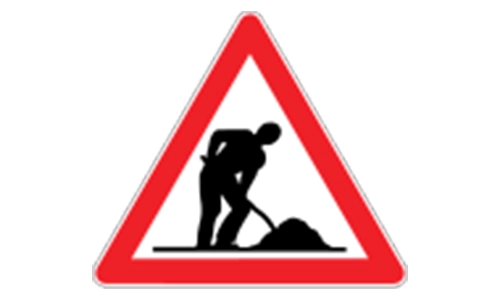
This warning sign indicates that road construction or maintenance work is taking place ahead. Drivers should slow down, stay alert, and be prepared for possible changes in road conditions such as uneven surfaces, narrowed lanes, or temporary diversions. Workers and equipment may also be present near the roadway, so extra caution is required. Temporary signs or flag signals must be followed carefully to ensure safety.
012/50
Progress
Driver Theory e-Exam 10
013/50
13.A circular sign with a red border and diagonal slash, white background, and black symbols showing a car, a person on a motorcycle, and a horse-drawn vehicle. What does this road sign indicate?
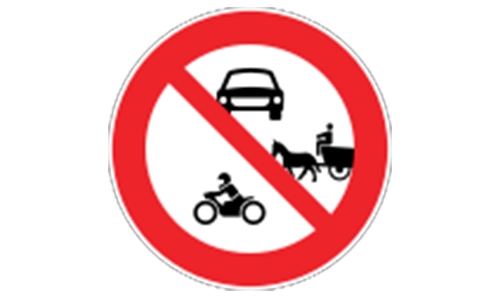
This circular prohibition sign indicates that neither motor vehicles (such as cars and motorcycles) nor animal-drawn vehicles are allowed to enter the road. It is typically used in pedestrian zones, restricted streets, or protected areas where all types of vehicular traffic are prohibited. Drivers and cart operators must not proceed beyond this point and should use an alternative route.
013/50
Progress
Driver Theory e-Exam 10
014/50
14.A square sign with a blue background, a thin white border, and a black symbol showing a fuel pump inside a white square in the center. What does this sign tell drivers?
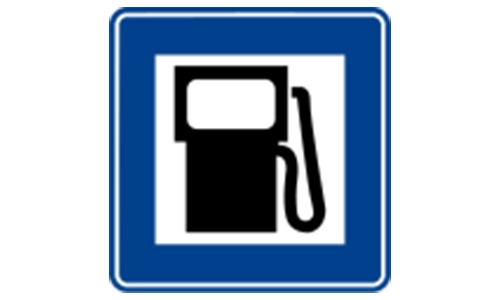
This informational sign indicates that a petrol or diesel fuel station is available nearby. It helps drivers plan refueling, especially on highways or long-distance routes where service stations may be far apart. Knowing this in advance ensures drivers can refuel safely without running out of fuel in remote areas.
014/50
Progress
Driver Theory e-Exam 10
015/50
15.What is the general speed limit for cars on Turkey’s motorways (otoyol)?
On Turkey’s motorways (otoyol), the general speed limit for passenger cars is 120 km/h, unless a lower limit is posted. This is the highest standard speed allowed and applies to high-quality, divided highways designed for fast and safe travel. However, drivers must always obey temporary or reduced speed limits in areas such as construction zones, heavy traffic, or poor weather conditions.
015/50
Progress
Driver Theory e-Exam 10
016/50
16.What is the purpose of lane arrows painted on the road before intersections in Turkey?
Lane arrows painted on the road before intersections in Turkey indicate the allowed directions for each lane such as turning left, going straight, or turning right. They help drivers choose the correct lane in advance and reduce confusion at intersections. Following these markings is important for smooth traffic flow and safety, as ignoring them can lead to sudden lane changes, traffic violations, and increased accident risk.
016/50
Progress
Driver Theory e-Exam 10
017/50
17.In areas with no traffic signs or markings, how should vehicles be parked on two-way streets?
In areas without traffic signs or road markings, vehicles on two-way streets must be parked on the right-hand side in the direction of traffic flow. This ensures safety and keeps traffic moving smoothly. Parking against the direction of traffic is generally not allowed unless the road is a one-way street or specifically marked otherwise.
017/50
Progress
Driver Theory e-Exam 10
018/50
18.Can a driver use hazard lights to park illegally “for a few minutes”?
Using hazard lights does not make illegal parking legal in Turkey. Hazard lights are intended only to warn other road users that a vehicle is stopped due to an emergency or breakdown. They do not give permission to park in restricted areas, even for a short time. Parking rules still apply, and misuse of hazard lights can still result in fines or penalties.
018/50
Progress
Driver Theory e-Exam 10
019/50
19.What is Turkey’s legal stance on drivers watching videos while driving?
In Turkey, watching videos while driving is strictly prohibited, regardless of whether it is on a phone, built-in screen, or any other device. It causes serious visual and mental distraction, reducing the driver’s attention to the road and increasing accident risk. This behavior is treated as a traffic violation and can result in fines and penalties because it severely compromises road safety.
019/50
Progress
Driver Theory e-Exam 10
020/50
20.What is your duty when a disabled pedestrian crosses without a marked crossing?
Even if there is no marked pedestrian crossing, drivers must give priority to disabled pedestrians and allow them to cross safely. Extra care and patience are required because they may move more slowly or need additional time and space. Drivers should stop if necessary, avoid rushing them, and ensure they can cross without any pressure or danger.
020/50
Progress
Driver Theory e-Exam 10
021/50
21.What happens when caught tailgating on highways?
Tailgating on highways in Turkey is treated as aggressive and unsafe driving. Drivers who do not maintain a safe following distance can be fined and may also receive demerit points on their license. This rule exists because following too closely reduces reaction time and greatly increases the risk of rear-end collisions, especially at high speeds.
021/50
Progress
Driver Theory e-Exam 10
022/50
22.When can children sit without any restraint system?
In Turkey, children cannot legally travel without a proper restraint system at any time. Child seats or appropriate safety systems must be used on all roads, regardless of distance or travel conditions. This law is in place to protect children from serious injury, as seatbelts designed for adults do not provide adequate safety for them.
022/50
Progress
Driver Theory e-Exam 10
023/50
23.What does defensive driving prioritize?
Predictable driving gives others time to react and prevents misunderstandings or accidents. Drivers avoid sudden, erratic movements, signal intentions clearly, and adhere to traffic laws. This consistency allows other road users to anticipate your actions, contributing to a safer driving environment for everyone.
023/50
Progress
Driver Theory e-Exam 10
024/50
24.What should drivers do when a traffic officer gives hand signals?
Hand signals from traffic police override all other traffic control devices, including traffic lights and road signs. Responsible drivers must obey these signals immediately and precisely, as officers are directing traffic based on real-time conditions to ensure safety and flow.
024/50
Progress
Driver Theory e-Exam 10
025/50
25.Why are bald tires dangerous in snow or rain?
Bald tires have worn-out treads that cannot effectively channel water away from the tires contact patch or grip snow. This significantly increases the risk of hydroplaning in rain and losing traction in snow, leading to skidding and loss of vehicle control.
025/50
Progress
Driver Theory e-Exam 10
026/50
26.What should you carry in your car during Turkish winters?
In case of long delays or breakdowns during Turkish winters, carrying emergency survival items like a warm blanket, snow chains if applicable, water, and non-perishable food is critical. These items provide warmth and sustenance if you become stranded in cold weather.
026/50
Progress
Driver Theory e-Exam 10
027/50
27.What should a driver do if they are running late and stressed?
When running late and feeling stressed, the safest action is to accept the delay and prioritize driving safely over trying to make up time. Speeding or engaging in risky maneuvers due to stress significantly increases the risk of an accident, ultimately causing more delay and potential harm.
027/50
Progress
Driver Theory e-Exam 10
028/50
28.What role does mirror use play in hazard perception?
Regular and proper use of all mirrors rear-view and side mirrors is crucial for detecting approaching dangers from behind, such as fast-approaching vehicles, motorcycles, or vehicles in your blind spots. This constant awareness of your surroundings is vital for comprehensive hazard perception.
028/50
Progress
Driver Theory e-Exam 10
029/50
29.What should you do if your car hydroplanes?
If your car hydroplanes loses traction on a wet road, ease off the accelerator pedal immediately. Do not brake hard or make sudden steering inputs, as this can worsen the skid. Steer gently and steadily in the direction you want to go, allowing the tires to regain contact with the road surface.
029/50
Progress
Driver Theory e-Exam 10
030/50
30.How does city driving differ in eco-efficiency from highway driving?
Highway driving is generally more fuel-efficient than city driving because it involves fewer stops, starts, and accelerations, allowing the vehicle to maintain a steady, optimal speed for longer periods. City driving, with its frequent braking and accelerating, consumes more fuel.
030/50
Progress
Driver Theory e-Exam 10
031/50
31.How does fatigue impair navigation?
Fatigue severely impairs a drivers cognitive functions, including attention and memory. This can lead to missing important road signs, failing to recognize familiar landmarks, and general confusion about directions, making navigation difficult and unsafe. it is always best to rest before long trips.
031/50
Progress
Driver Theory e-Exam 10
032/50
32.A triangular sign with a red border, white background, and a black symbol showing vertically arranged red, yellow, and green lights. What does this road sign indicate?
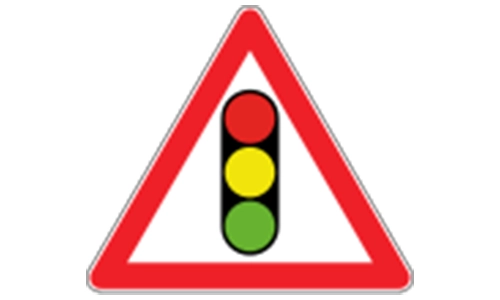
This warning sign indicates that a traffic light-controlled intersection is approaching. Drivers should slow down, stay alert, and be prepared to stop or proceed according to the signal. It is important not to speed up when the light may be about to change, as intersections require careful attention and safe decision-making.
032/50
Progress
Driver Theory e-Exam 10
033/50
33.A circular sign with a thick red border, white background, and a black symbol showing "2,30 m" between two horizontal arrowheads pointing towards each other. What does this road sign indicate?
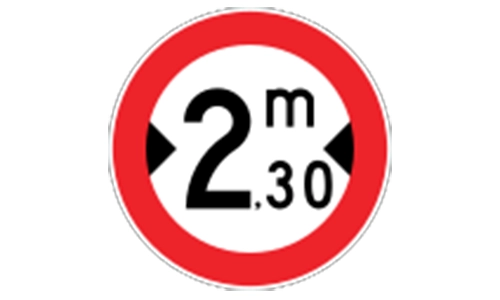
This circular prohibition sign indicates a maximum width restriction (2.30 m in this case). Vehicles that exceed this width are not allowed to enter the road, tunnel, or bridge ahead. It is used in narrow roads or structures where wider vehicles could cause obstruction or safety risks. Drivers of large vehicles must ensure their vehicle width complies with the stated limit before proceeding.
033/50
Progress
Driver Theory e-Exam 10
034/50
34.A square sign with a blue border, white background, and a black symbol showing a bed in the center. What does this sign indicate on highways?
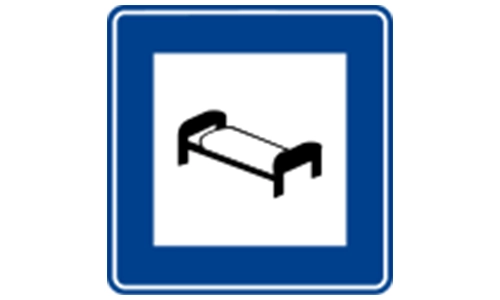
This informational sign indicates that accommodation facilities such as hotels or rest areas are available nearby. It is commonly used on highways to help drivers plan rest stops during long journeys. It improves travel comfort and safety by allowing drivers to take breaks and avoid fatigue.
034/50
Progress
Driver Theory e-Exam 10
035/50
35.What is the speed limit for motorcycles on Turkish rural roads (non-urban, undivided)?
On rural two-way roads, motorcycles have the same default limit as cars , 90 km/h. However, riders must exercise caution as these roads often lack barriers and may have sharp curves or unexpected hazards. Wearing helmets and maintaining visibility are crucial for safety.
035/50
Progress
Driver Theory e-Exam 10
036/50
36.Is it legal to use the emergency lane for overtaking in Turkey?
The emergency lane is strictly reserved for breakdowns, emergency services, and authorized vehicles. Using it for overtaking is illegal and considered highly dangerous, attracting heavy penalties.
036/50
Progress
Driver Theory e-Exam 10
037/50
37.What does a blue “P” sign indicate in Turkey?
The blue “P” sign marks legal parking zones. In Turkey, these areas may be free or paid, depending on nearby signs. Drivers should check for any restrictions or payment instructions before leaving their vehicle.The blue “P” sign marks legal parking zones. In Turkey, these areas may be free or paid, depending on nearby signs. Drivers should check for any restrictions or payment instructions before leaving their vehicle.
037/50
Progress
Driver Theory e-Exam 10
038/50
38.When driving through fog at night, which lights should be used?
High beams can scatter in fog and reduce visibility. Turkish drivers are advised to use fog lights in combination with low beams to remain visible and avoid glare.
038/50
Progress
Driver Theory e-Exam 10
039/50
39.Can voice assistants (e.g., Siri, Google Assistant) be safely used while driving?
Voice assistants are legal but still cognitively distracting. They should only be used for essential and brief functions and never take mental focus away from the road.
039/50
Progress
Driver Theory e-Exam 10
040/50
40.When a group of cyclists approaches a narrow bridge, what should the driver do?
Cyclists are vulnerable, especially in confined areas like narrow bridges. Drivers must yield and provide ample space to ensure their balance and safety. Forcing a pass can cause serious accidents.
040/50
Progress
Driver Theory e-Exam 10
041/50
41.What is the result of repeat traffic violations within a year?
In Turkey, repeat traffic violations within a certain period can lead to increased penalties. In many cases, committing the same offense again within a year results in a doubling of the fine (100% increase). This stricter penalty is designed to discourage repeated unsafe driving behavior and encourage compliance with traffic rules.
041/50
Progress
Driver Theory e-Exam 10
042/50
42.What action must drivers take if a child is crying in the seat?
If a child is crying in the vehicle, the driver should not try to handle the situation while driving, as this can cause distraction and reduce road safety. Instead, the safest action is to find a safe place to stop, park properly, and then attend to the child. The driver must always prioritize safe driving and only address passenger needs when the vehicle is stationary.
042/50
Progress
Driver Theory e-Exam 10
043/50
43.What to do if brakes fail while driving?
In brake failure, pumping the brake pedal rapidly may restore hydraulic pressure. If that doesnt work, gradually apply the handbrake, gently releasing it if the wheels lock, to bring the car to a controlled stop. Downshifting to lower gears also uses engine braking to slow the vehicle.
043/50
Progress
Driver Theory e-Exam 10
044/50
44.Why should children always ride in the back seat?
Turkish traffic law mandates children under 135 cm or generally children under a certain age/height to use rear seats with proper restraints child seats/boosters for their safety. The back seat is generally safer as it is further from the direct impact zone in front-end collisions and away from airbags designed for adults.
044/50
Progress
Driver Theory e-Exam 10
045/50
45.What is the use of ABS on slippery roads?
ABS Anti-lock Braking System is designed to prevent wheels from locking up during hard braking, especially on slippery roads. By rapidly pulsing the brakes, ABS allows the driver to maintain steering control while braking, reducing the chances of skidding and improving stopping stability.
045/50
Progress
Driver Theory e-Exam 10
046/50
46.What is the first thing to do in case of a tunnel fire?
In case of a tunnel fire or heavy smoke, the first priority is personal safety. If you can, drive through the fire/smoke to the nearest exit. If not, stop, turn off the engine, leave the keys in the ignition, and immediately evacuate the tunnel using the nearest emergency exit.
046/50
Progress
Driver Theory e-Exam 10
047/50
47.How does music affect your driving mood?
Calm or soothing music can help ease stress, reduce tension, and maintain emotional balance during challenging drives or in traffic. Conversely, very loud or aggressive music can sometimes contribute to aggressive driving.
047/50
Progress
Driver Theory e-Exam 10
048/50
48.What is a common hazard when driving through residential areas?
In residential neighborhoods, a common and significant hazard is children or pets unexpectedly running into the road from between parked cars, driveways, or yards. Drivers must maintain slower speeds and high alertness to react in time to these unpredictable movements.
048/50
Progress
Driver Theory e-Exam 10
049/50
49.What must you do after your vehicle stalls in traffic?
If your vehicle stalls in traffic, the first priority after turning on hazard lights is to move it out of the active traffic lane to the safest possible location, such as the shoulder or a parking area. This reduces the risk of secondary accidents caused by your stationary vehicle.
049/50
Progress
Driver Theory e-Exam 10
050/50
50.What is the eco-driving benefit of using engine braking?
Engine braking decelerating by releasing the accelerator pedal and allowing the engine to slow the vehicle saves fuel because the fuel supply to the engine is often cut off during this process. It also reduces reliance on the friction brakes, prolonging their life.
050/50
Progress
- 1
- 2
- 3
- 4
- 5
- 6
- 7
- 8
- 9
- 10
- 11
- 12
- 13
- 14
- 15
- 16
- 17
- 18
- 19
- 20
- 21
- 22
- 23
- 24
- 25
- 26
- 27
- 28
- 29
- 30
- 31
- 32
- 33
- 34
- 35
- 36
- 37
- 38
- 39
- 40
- 41
- 42
- 43
- 44
- 45
- 46
- 47
- 48
- 49
- 50
0 Correct
x 0 Incorrect
- Passing Score 80%

Ace the DMV Exam on Your First Attempt
Unlimited mock tests
Access Over 1000 Exam Like Questions for Just $3

Ace the DMV Exam on
Your First Attempt